The challenge
Collecting generic points works, but it doesn't always show customers how close they are to getting something real. Without a tangible, visible goal (a specific product, with clear progress), customers are more likely to lose interest before they get there, and it's harder for the business to steer purchases towards the categories it cares about.
How it works
The reward is set on one or more specific products, each with its own points threshold and, optionally, a small additional amount payable on redemption.
Illustrative examples
Three different ways to apply rewards, depending on the sector and the business goal.
Benefits
Every purchase brings the customer closer to a reward. Every reward increases the likelihood of the next purchase.
Impact
Higher average spend
The more customers spend, the faster they reach the goal, which encourages higher-value purchases.
A tangible hook
A specific product motivates more than abstract points with no clear goal.
Controlled profitability
Additional amounts, limits and conditions fine-tune the real cost of each reward.
See it in Wapping Manager
When you set up the reward, you choose the product, the required points and any additional amount. Customers see their progress towards each reward directly in their wallet.
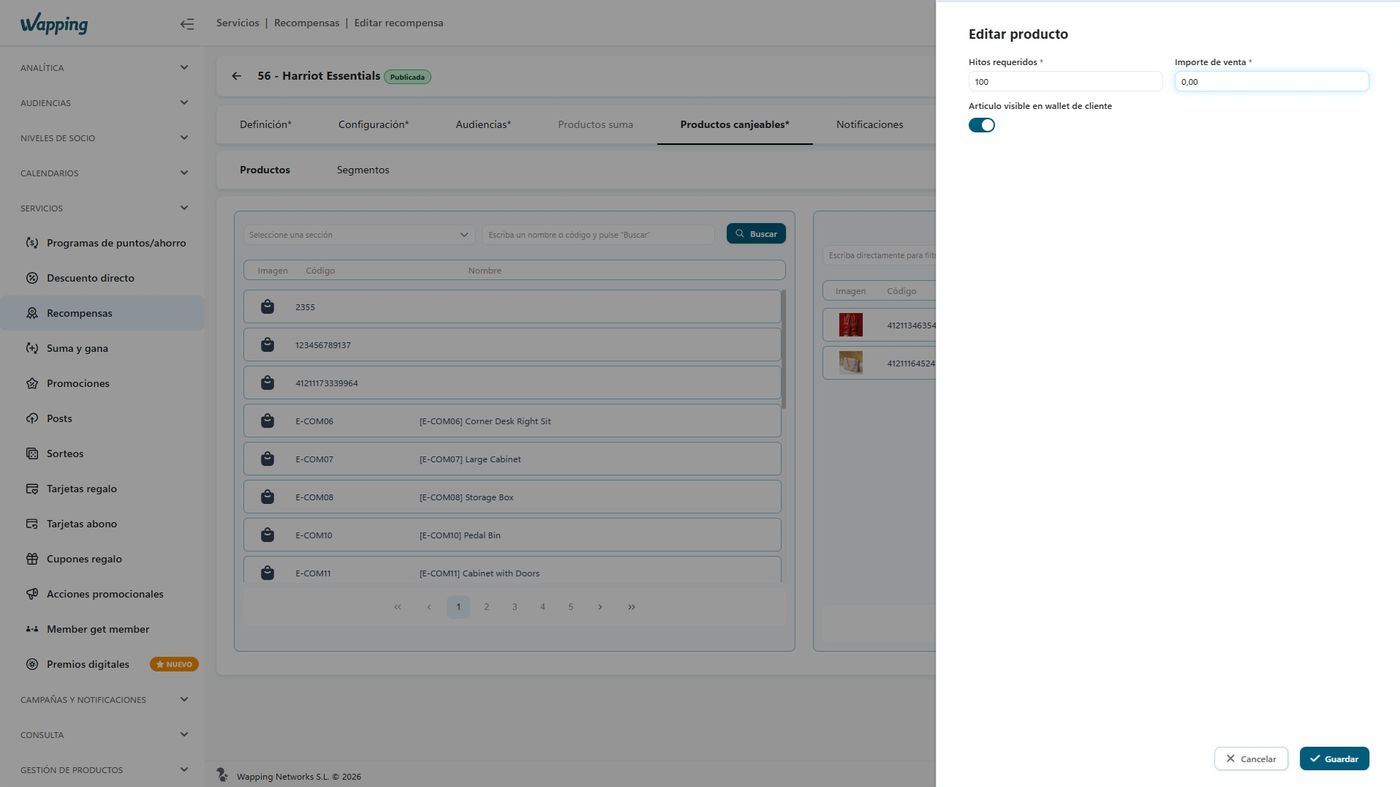
Challenges / Rewards

Wapping vs the traditional approach
| Aspect | Traditional approach | Wapping |
|---|---|---|
| Programme goal | Generic points with no clear goal | A specific product, visible from the start |
| Progression of prizes | A single fixed prize | Several tiered milestones in the same programme |
| Cost to the business | Hard to adjust | Additional amount configurable per reward |
| Steering demand | Rarely possible | Earning limited to specific products or categories |
Use case: marketing
Marketing wants to boost accessory sales in womenswear. Instead of a generic discount, the team creates a reward: a seasonal necklace, unlocked at 10 points, with 1 point earned for every €50 spent in that category only. Customers see their progress in their wallet, the category gains traction and the business knows exactly what the programme will cost in advance.
Frequently asked questions
A reward is tied to one or more specific products that the customer unlocks on reaching a set number of points. Earn & Burn offers an open catalogue of redeemable services (promotions, gift cards, coupons). They are independent mechanics that can be used separately or together.
Yes, it's optional. The reward can be completely free once the customer reaches the required points, or carry a small additional amount that they pay on redemption.
Yes. The purchase amount that earns points can be based on the receipt total or on certain products only, so you can steer the programme towards the categories that matter most to your business.
Yes. A single programme can link several products as different rewards, each with its own points threshold and additional amount, creating a progression of prizes.
We'll show you how to design your first rewards programme around your own catalogue.