The challenge
A generic promotion, sent at the same time to the entire customer base, treats someone who buys every week the same as someone who hasn't bought in a year. Without real segmentation, marketing has only two options: speak to everyone the same way, or build audiences by hand with exports that are outdated as soon as they're generated.
How it works
Each type of segment meets a different need: depth of analysis, immediacy, or risk control.
RFM in detail
Wapping calculates Recency, Frequency, and Monetary Value automatically, and translates each into a score from 1 to 5. Combined, the three scores pinpoint very specific customer profiles.
Examples of RFM profiles
What's included
Benefits
Your customers aren't all the same. Make every connection more relevant.
Impact
50+ native criteria
No custom development needed to combine customer, purchase, and behavior variables.
Automatic updates
Segments update automatically, throughout the day or in real time.
0 manual exports
Audiences are always live and ready to activate from the same platform.
See it in Wapping Manager
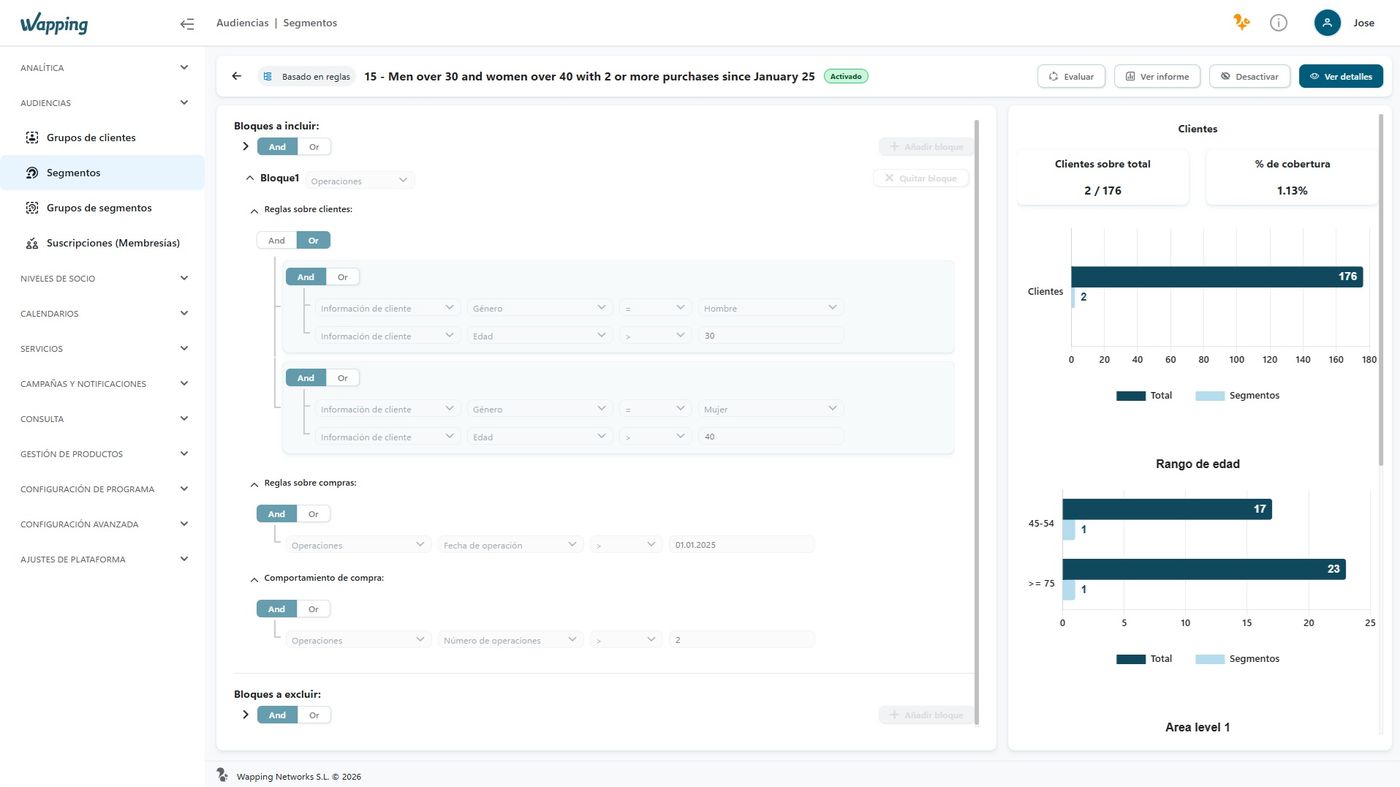
When creating a segment, you choose its type (rule-based, RFM, real-time, or fraud) and add the necessary conditions. On the right, an embedded analytics panel shows in real time how many customers match.
Dynamic Audiences

Wapping vs. the traditional approach
| Aspect | Traditional approach | Wapping |
|---|---|---|
| Segment updates | One-off manual exports | Automatic, throughout the day or in real time |
| Depth of criteria | A few basic fields | 50+ native criteria, combinable without limit |
| Historical customer value | Manual or nonexistent calculation | Automatic RFM over the last 12 months |
| Your own business data | Hard to incorporate | Custom events as a native criterion |
Use case — Marketing
Without dynamic segmentation, marketing tends to send the same promotion to the entire base, because building specific audiences by hand takes time and quickly becomes obsolete. With Wapping, an RFM 155 segment ("lapsed loyal customers") can be activated with a reactivation promotion in minutes, and the segment itself stays up to date: customers who buy again automatically leave that audience.
Frequently asked questions
More than 50 native criteria, combinable without limit: demographic, transactional, behavioral, geographic, and brand-relationship variables, plus custom events defined by the business itself.
RFM classifies each customer by the Recency, Frequency, and Monetary Value of their purchases over the last 12 months, with a score from 1 to 5 in each dimension. Wapping calculates these values automatically from the transaction history, and can also apply the same logic to returns. You can also define fully custom RFM segments and use them in any action, campaign, or loyalty service.
Yes. Rule-based segments are automatically re-evaluated throughout the day and real-time segments update instantly, so a customer enters or leaves an audience as soon as the data that defines it changes, with no manual recalculations.
Yes, with real-time segments, designed for cases where immediacy matters: for example, applying a welcome discount as soon as a new customer registers.
We'll show you how to build your first segments on your own customer base.