The challenge
Without a reliable customer identity, everything else fails
Most platforms build the customer profile by stitching together the data they already have: email sign-ups per channel, POS IDs, Ecommerce accounts. The result is duplicate customers, accounts created on the fly to grab a welcome offer, and merge & curation processes that never quite clean up the data.
How it works
Two worlds: physical and online. One verified identity.
Physical stores and Ecommerce are different environments, but customers verify their identity with an OTP only once, when they sign up. That single verification, shared by both worlds, unifies their online and offline behavior under one guaranteed identity.
Web form
Self-service registration from the brand's site.
Assisted in store
Sales associates enter the details; the customer verifies their mobile number.
Sign up right in the chat by scanning a QR code.
APP
Native sign-up with immediate access to the wallet.
Physical card
A QR code linked to a physical card.
Ecommerce
Sign-up built into online account creation, with the same OTP.
Mobile verification works the same way in store and online. That's why customers don't end up with a "store" profile and a separate "online" one: they have a single ID that unifies all their purchase behavior.
After registration
Reliable identification at every purchase
Once verified, customers identify themselves at checkout seamlessly, through their preferred channel, with the same level of security every time.
The QR is always dynamic and single-use: it expires after each purchase, so a shared or reused screenshot cannot be used to impersonate the customer.
What's included
Module capabilities
Benefits
Other loyalty solutions unify transactions. Wapping verifies identities.
- Reliable data from the source. No more relying on misspelled, shared, or mistyped email addresses at checkout: every profile is verified and belongs to a real customer.
- One customer, one profile. No more multiple profiles for the same person, or transactions from different customers mixed under one ID.
- Far more precise personalization. Promotions, benefits, and communications are based on a reliable identity, increasing the relevance of marketing actions.
- Measurement and segmentation you can trust. Audiences, CLV, purchase frequency, and campaign ROI are not distorted by duplicated or misidentified profiles.
- A single service wallet for each customer. Points, promotions, coupons, cashback, gift cards, digital receipts, and any other benefit are managed on a single identity that is consistent across all channels.
"One customer. One profile. One truth."
Impact
What your business gains
1 unique identifier
For all 6 registration channels: web form, store, WhatsApp, APP, physical card, and Ecommerce.
0 duplicate accounts
Thanks to mobile OTP verification at sign-up.
100% traceability
Of every consent and legal term each customer accepts.
See it in Wapping Manager
The whole customer, on a single screen
From the Customers search, the team accesses the complete record: personal data, segments, last visit, sales and returns, active services in the wallet, and the Linked Accounts tab, with a breakdown by channel.
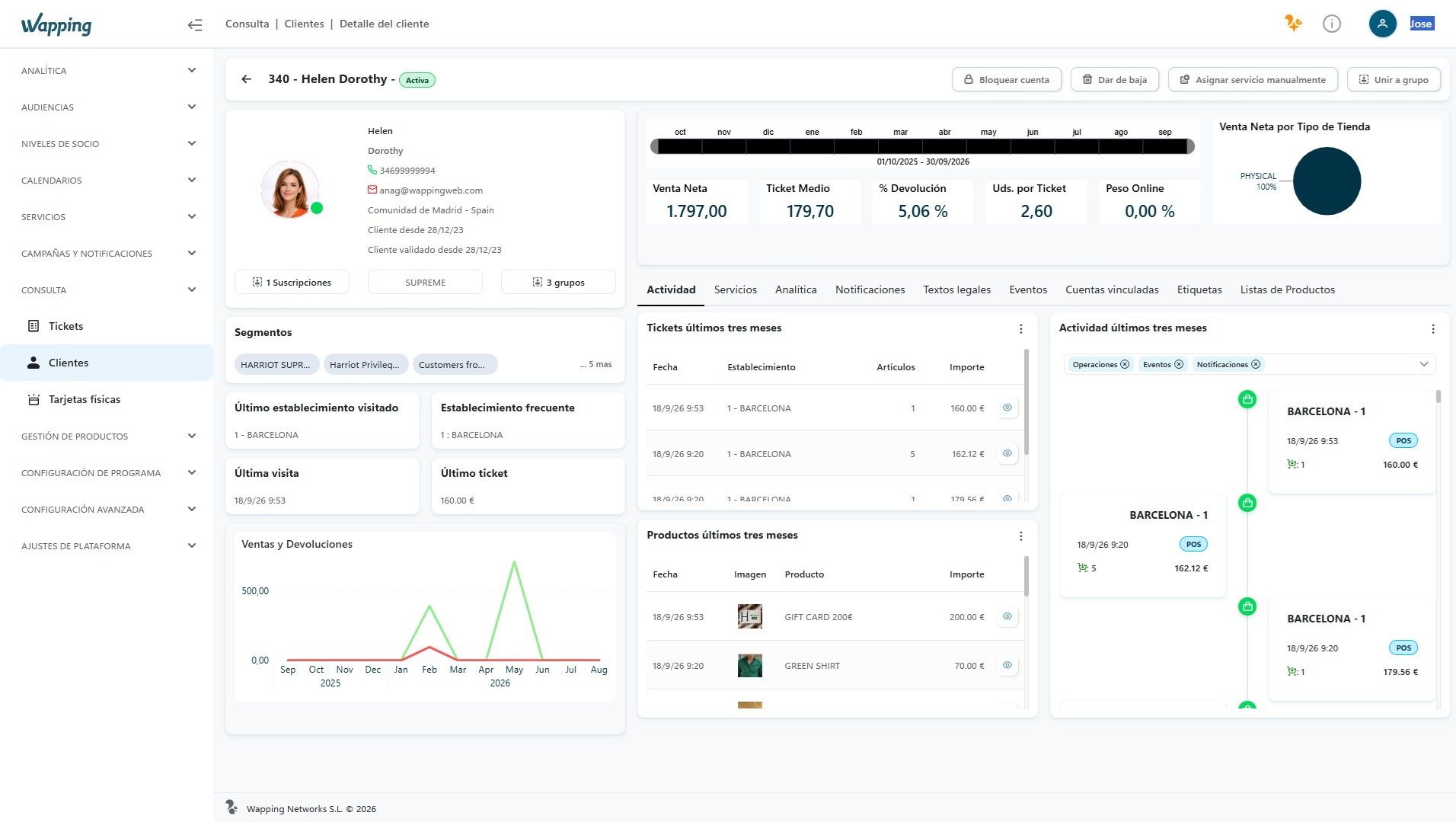
Unified 360° Customer Profile
Wapping vs. the traditional approach
The difference lies in where the data comes from
| Aspect | Traditional approach | Wapping |
|---|---|---|
| Source of identity | Stitching together existing data silos | Mobile OTP verification at sign-up |
| Duplicates | Frequent, requiring continuous cleanup | Prevented at the source |
| Fake accounts for promos | Possible with just an email | Blocked by requiring a verified mobile number |
| Visibility into customer channels | Limited or nonexistent | "Linked Accounts" panel on the customer record |
Use case — Marketing
Personalization with full confidence
With a unique, guaranteed customer, marketing can design personalized promotions, tiers, and rewards knowing the segment is accurate. Without that reliability, the same customer shows up split across several profiles: the segment is calculated wrongly, a welcome discount can fire twice for the same person, and the real impact of the campaign can no longer be measured with confidence. This is where every activation and loyalty strategy starts.