The loyalty software market for retail has grown significantly in recent years. There are many options, with very different approaches, and making the wrong choice has a real cost: wasted implementation time, data silos, teams that don’t adopt the tool, and loyalty programs that fail to deliver the expected return.
Most mistakes when choosing a customer loyalty platform don’t come from picking a bad solution. They come from choosing a solution that doesn’t fit the real needs of the business, or from not asking the right questions before signing.
In this post, we don’t give you a ranking of tools. We give you the criteria you should evaluate, the most common mistakes, and a checklist of questions you can use with any vendor before making a decision.
What is loyalty software and what it should do
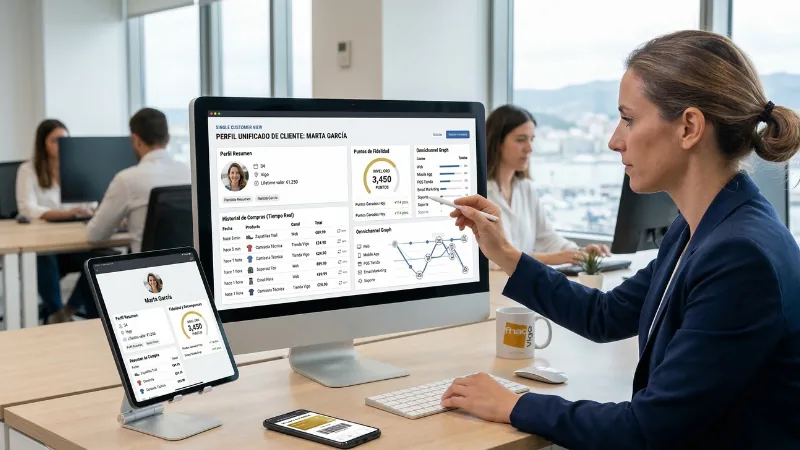
Customer loyalty software is a platform that allows you to design, manage, and activate loyalty programs: point accumulation, rewards, personalized discounts, exclusive benefits, and any mechanism that encourages customers to return and deepen their relationship with the brand.
But a strong customer loyalty system does much more than manage points. In an omnichannel retail environment, it should be able to:
- Identify the customer across any channel, whether in-store, ecommerce, or app, and treat them consistently across all touchpoints.
- Unify behavioral and purchase data into a single, real-time updated customer profile.
- Dynamically segment the customer base and apply different incentives based on profile, timing, or channel.
- Activate personalized communications based on real purchase events, not just generic campaign calendars.
- Measure program impact on real business metrics: purchase frequency, average order value, retention, and CLV.
Most common mistakes when choosing loyalty software
Before diving into evaluation criteria, it’s important to understand the most common mistakes. Many of them are avoidable if the right questions are asked from the start:
| Selection mistake | Real consequence |
| Choosing based on price without evaluating integrations | The system doesn’t connect with POS or ecommerce, and data remains in silos |
| Prioritizing features over usability | Teams don’t use it, adoption fails |
| Ignoring scalability | The software becomes insufficient within 12–18 months |
| Not requiring real-time data | Campaigns are triggered late or with outdated information |
| Confusing CRM with a loyalty platform | Communication is managed, but loyalty isn’t built and experiences aren’t personalized |
| Underestimating implementation support | Go-live is delayed and ROI takes longer to materialize |
The most common mistake of all isn’t in the table: making a decision without first defining what problem you want to solve and what results you expect within 12 months.
Key criteria to evaluate a customer loyalty platform
- True omnichannel, not just claimed
It’s not enough to say it’s omnichannel. Customers must be able to earn and redeem benefits consistently across store, web, and app, with data synchronized in real time. Otherwise, the experience loses credibility.
- Integration with your current tech stack
The platform must integrate easily with POS, ecommerce, and ERP. Prioritize native connectors and an open API to ensure fast and scalable implementation.
- Built-in CDP and customer data management
You need a unified customer profile, updated in real time and without duplicates. Without proper data management, there is no effective personalization or segmentation.
- Flexibility in program design
Look for a solution that allows you to adapt rules, benefits, and mechanics (points, referrals, gamification) to your business without constant IT dependency.
- Dynamic segmentation and customer value models
The platform should automatically segment based on behavior and apply models like RFM. The value lies in behavioral data, not demographic data.
- Integrated omnichannel communications
Loyalty and marketing should be connected. Ideally, the platform should activate campaigns (email, SMS, WhatsApp, app) from the same system without manual processes.
- Analytics on program impact
Basic metrics are not enough. You need visibility into CLV, purchase frequency, retention, and performance by segment to optimize decisions.
- Scalability and performance
Evaluate whether the platform can grow with your business and maintain performance during demand peaks such as campaigns or sales periods.
- Regulatory compliance (GDPR)
It must ensure consent management, the right to be forgotten, and data security. This is critical both legally and reputationally.
- Implementation, support, and onboarding
The vendor should provide clear onboarding, ongoing support, and real guidance. Technology without execution does not deliver results.
A provider that sells the tool and disappears after signing is not a good partner for a long-term loyalty project.
Checklist: questions to ask any loyalty software vendor
| Evaluation criteria | Key questions to ask the vendor |
| True omnichannel | Does it work the same in-store and online? Is data synchronized in real time? |
| POS and ecommerce integration | Does it have native connectors with my POS and ecommerce platform? How long does integration take? |
| Built-in or compatible CDP | Does it manage first-party data? Does it build a unified customer profile? |
| Program personalization | Can I create different rules by segment, store, product, or calendar without IT? |
| Dynamic segmentation | Are segments updated in real time? Can I apply RFM or other customer value models? |
| Omnichannel communications | Does it include email, SMS, WhatsApp, app, and mobile wallet from the same platform? |
| Analytics and reporting | What metrics does it measure? Can I see CLV, purchase frequency, and retention by segment? |
| Scalability | Can it support the volume of customers and transactions I’ll have in 2–3 years? |
| GDPR compliance | Does it manage consent? Does it support the right to be forgotten? Where is data stored? |
| Support and implementation | What support is provided during onboarding? Is there a dedicated team? |
What differentiates a basic loyalty platform from an end-to-end solution

Not all tools on the market offer the same level of integration and functionality. Broadly speaking, there are three types of solutions:
- Points management tools: handle the basic mechanics of a program (issuing and redeeming points) but offer limited capabilities in personalization, segmentation, and integration. Suitable for small businesses with low data volume.
- Specialized loyalty platforms: offer more flexibility in program design and some segmentation capabilities but often require external integrations for communications and advanced analytics.
- End-to-end intelligence and loyalty solutions: combine customer data management (CDP), loyalty programs, omnichannel communications, and analytics in a single system. They are the most complete option for omnichannel retailers with significant data volume.
The choice between these depends on business size, customer volume, omnichannel complexity, and the level of personalization required. For retailers operating across multiple channels with an active customer base, an end-to-end solution is almost always the most cost-effective option in the long term.
Wapping: a customer loyalty platform for omnichannel retail
If you’ve made it this far with clear criteria, it’s worth understanding what Wapping offers as an end-to-end intelligence and loyalty solution for retail.
- CDP with unique customer ID: unified omnichannel profile, built and updated in real time from in-store, ecommerce, and app data, without duplicates.
- Customizable loyalty engine: design points programs, rewards, discounts, and experiences without IT. With restrictions by product, store, segment, or calendar.
- Advanced dynamic segmentation: over 50 segmentation parameters, real-time updates, compatible with RFM analysis and customer value models.
- Integrated omnichannel communications: email, SMS, WhatsApp, app, and mobile wallet from a single platform, triggered by real purchase events.
- Business analytics and reporting: CLV, purchase frequency, retention, and program impact by segment and channel.
- Native integrations: with leading POS systems and connectors with major ecommerce platforms.
It is used by leading retailers in fashion, grocery, and beauty, with measurable results in purchase frequency, average order value, and customer retention.
Conclusion
Choosing loyalty software is not a decision that should be based solely on price or the number of features shown in a demo.
The most important question is whether that platform can connect your data, personalize each customer’s experience, and measure real business impact. Everything else is secondary.
Use the checklist in this article as a starting point in any evaluation process. And if you don’t yet have clear requirements, start by defining what problem you want to solve and what result you expect in the next 12 months. The right tool is always the one that fits that objective.