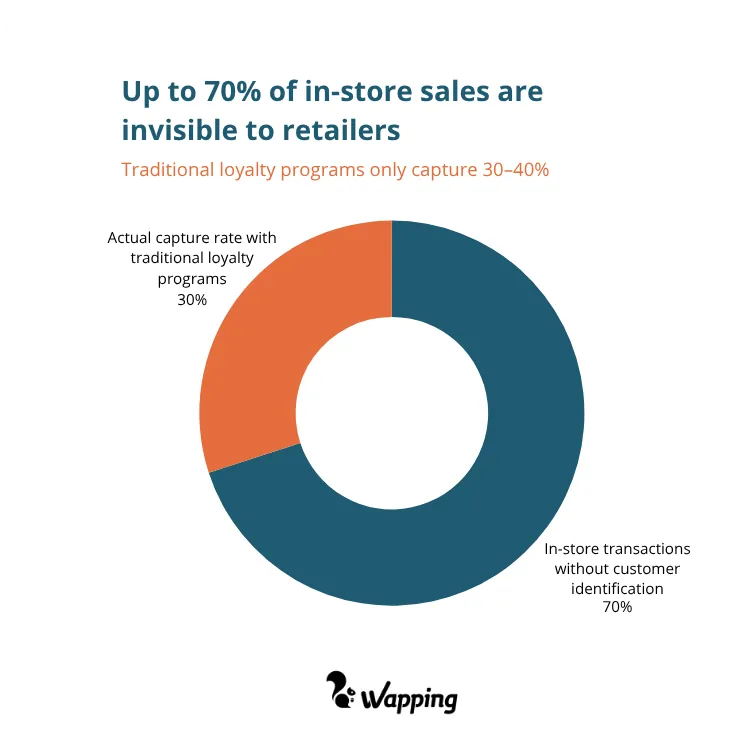
Between 60 and 70% of in-store transactions in Spain are not linked to any customer profile. Sales happen, get logged in the POS, and vanish. Nobody knows who paid, what they bought before, or when they'll come back. This isn't a motivation problem or a strategy problem. It's a data architecture problem. And in 2026, with new-customer acquisition costs still rising and margins in mid-market retail tightening, running two-thirds of your business invisible has direct consequences on the bottom line. A CDP is not a more sophisticated CRM or an advanced email marketing tool. It's the system that lets you know, for the first time, who each person is when they walk through your door or land on your website: a single, clean, actionable profile from the very first checkout. This guide explains what a retail CDP is, how it works, what problems it solves and when it makes sense to implement one. No theory. Just the data and use cases that matter.
1. 1. What a retail CDP is, and what it isn't
CDP, CRM and DMP: three tools, three different problems

Confusing these acronyms costs retailers months of wasted projects and poor decisions. Worth getting it straight:
- CRM: manages relationships with already-known customers. In retail, it only captures the customer that someone decides to register manually. It has no access to POS transaction data and has no visibility into what happens in the physical store.
- DMP: worked with anonymous, third-party cookie data to segment audiences in paid media. In 2026, with cookies gone from all major browsers, the standalone DMP has lost its strategic rationale.
- CDP: works with first-party data, identifies real people and builds persistent individual profiles. It doesn't segment anonymous masses, it identifies known individuals.
In retail, where the challenge is knowing that the customer who bought on Tuesday in-store is the same one who ordered online on Saturday, that distinction changes everything.
A retail-native CDP operates at checkout, in real time, as a services gateway that fires in the millisecond the transaction is processed. That's what separates a platform built for real retail from a digital solution retrofitted to include physical stores as a secondary channel.
Why a generic CDP isn't the same as a retail CDP
General-purpose CDPs assume the customer already exists in some online system. Physical retail works the other way around: the customer exists first in-store, pays at the POS, and if the platform isn't connected to the point of sale at the moment of payment, the data is lost. The architecture of Wapping's loyalty platform is designed to operate as a gateway at checkout, both in POS and ecommerce, without modifying the ERP or pricing engine.
2. The root problem: the retailer who doesn't know their customers
The ghost customer
Traditional loyalty cards capture between 30 and 40% of in-store tickets. The rest, the majority, are anonymous transactions. Money in, product out, and no record of who was there. The marketing team makes decisions based on segments representing, at most, a third of the actual business. The most frequent customers, the most profitable, the ones about to churn: invisible to the very tool that's supposed to retain them.
Duplicates: the silent error that corrupts everything
The same customer appears three times in the database: once in the POS, once in ecommerce, once in the CRM. They were created with and without an accent in two different systems. They bought before ecommerce existed and their old profile was never merged with the new one. The result: reactivation campaigns that arrive twice as if they're two different people. Welcome offers for someone who's been buying for five years. High-value segments that exclude half the transactions because they're spread across records the system doesn't recognize as the same person.
When the data can't be trusted, every campaign becomes a gamble. The team avoids segmenting, avoids personalizing, and ends up sending the same message with the highest possible discount to make up for the lack of precision. That's how the mass flyer with the 30% off is born, the one that eats margin without building loyalty.
3. How a retail-native CDP works: the unique customer ID
The profile that starts clean from the very first checkout
A retail-native CDP creates a unique customer ID, validated at the moment of the transaction, the first time that person interacts with the business, on any channel. If they come in through the physical store, the ID is created at the POS. If they come through the website, it's created at the ecommerce checkout. From that point on, all future interactions accumulate on that single profile. No later merging. No deduplication projects. No nightly ETL trying to reconcile systems that don't talk to each other.
OTP: how identity is validated at the point of sale
A mobile number validated by OTP is the anchor of the profile. The process: the POS asks for the number, the customer receives an SMS with a code, enters it, and is identified. Thirty seconds. No plastic cards that get lost, no forms that nobody fills in correctly.
72% of enrolments to loyalty programs in retailers with active WhatsApp happen through that channel. Not the app. Not the web form. WhatsApp, the channel where the customer already lives, with the least possible friction.
More information on how WhatsApp onboarding works in the Wapping platform.
Physical and digital: the same customer, the same profile
The customer who has bought three times in-store this month and just placed their first online order does not appear as a new customer in ecommerce. They appear as who they actually are: someone with a purchase history, known preferences and a real value calculated across all their transactions. For marketing: segmentation based on the complete reality of the customer. For IT: no synchronizations to maintain between systems that speak different languages. For the business: every new data point enriches the profile instead of creating a duplicate.
4. From data to business: omnichannel loyalty at checkout
Why classic points programs don't build loyalty
The points balance isn't visible in real time across all channels. What's been accumulated in-store can't be redeemed online. The app shows a different balance to the customer portal. The customer doesn't know how much they have or how to use it. The program exists, but it doesn't build loyalty, it generates points accounting, not customer behavior.
The difference between a classic points program and a real omnichannel loyalty engine isn't the mechanics. It's the architecture: same balance, same rules, same benefits at every touchpoint, updated in real time.
The transactional gateway: the benefit at the moment of payment
When the customer goes to pay, the POS or the ecommerce queries the platform in real time. The platform calculates what benefits apply, line discounts, points to accrue, active promotion, membership level, and return them applied. The benefit happens at checkout, not promised for later.
< 300 ms average response time: checkout → platform → benefit applied
The practical consequences: total attribution (every benefit is tied to the sale that triggered it) and marketing autonomy without touching the ERP. A 'double points on footwear this weekend in Madrid' campaign doesn't require opening a ticket to IT.
5. What changes when you have clean data: real use cases
Detecting the customer who is about to leave
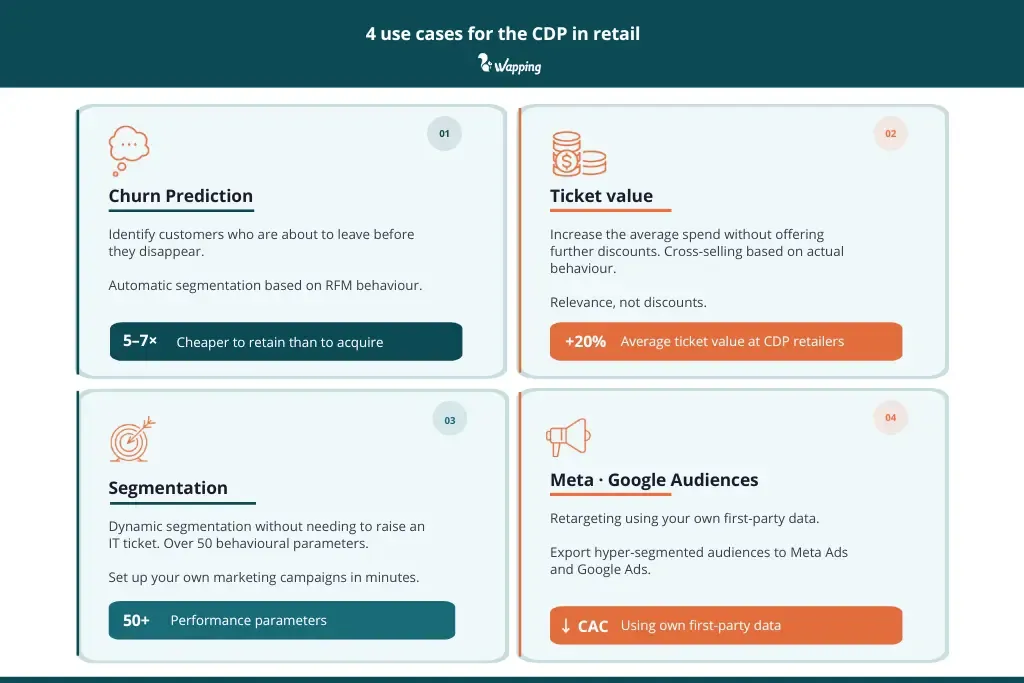
A customer who historically buys every three weeks and hasn't been seen in six is sending a signal. The platform can automatically segment those profiles and trigger a reactivation campaign with an incentive calibrated to the customer's historical value and the available margin in their usual categories.
The cost of retaining an at-risk customer is five to seven times lower than acquiring a new one. For a mid-size retailer with 50,000 active customers, recovering just 5% of those about to churn has a direct impact on the total LTV of the base.
Increasing basket size without discounting more
With a unified profile, cross-category matching is precise. You know which categories the customer buys, which ones they've never touched, and when the right moment for the suggestion is. The difference vs the generic campaign is not the discount. It's the relevance.
+20% average basket size in cross-sell campaigns based on real behavior · retailers in production
Dynamic segmentation without IT tickets
Segments are defined by behavioural rules and update automatically as the customer changes. The marketing team creates and activates them independently, no technical dependency, in minutes, across more than 50 parameters: recency, frequency, monetary value (RFM), preferred channel, membership level, return history, response to previous communications.
Audiences for Meta and Google from your own data
With third-party cookies gone, CAC in paid channels rises without a clear lever to offset it. A retailer with an active CDP can export hyper-segmented audiences directly to Meta Ads and Google Ads: customers of a specific category who haven't returned in 30 days, high-value profiles from a particular store, customers whose purchase pattern suggests an imminent repurchase. Retargeting on first-party data converts better and reduces CAC.
6. When does a retailer need a CDP?
The signals that say now is the time
- Your marketing team can't run a segmented campaign without going through IT, and the cycle takes days or weeks.
- Your loyalty program exists, but doesn't work consistently across all channels and you can't prove its ROI with hard data.
- You have duplicates in your database that you can't resolve systematically.
- Your CAC in paid channels has risen more than 30% over the past two years with no sufficient first-party data to compensate.
- You're opening new stores, launching an ecommerce or integrating an acquired chain, and you need all those flows to sit under a single profile from day one.
The profile that benefits most, and the one that doesn't need it yet
Best return: retailer with revenue between €10M and €200M, phygital presence, in high-purchase-frequency sectors (fashion, speciality food, beauty, organized hospitality, opticians) and more than 10,000 active buyers per year. Doesn't need it yet: fewer than 5,000 active customers (not enough data mass), purely online retailer with no offline-digital unification challenge, or those who already have a stable enterprise CDP with a dedicated technical team. Not sure if the timing is right for your business? Talk to our team, no commitment and no product demo if you'd rather not.
7. The Myth of the 18-Month Project
A 1-API Architecture: Weeks, Not Months
Instead of requiring data migration, ERP modifications, or a complete rewrite of the pricing engine, the platform connects to the checkout, POS, and ecommerce systems through a single REST API. The business logic lives within the platform, not within the retailer’s systems. Zero development on the customer side.
4–12 weeks to go live vs. 6–18 months for generalist CDPs or custom developments
Native modules for Shopify, Salesforce Commerce Cloud, Prestashop, and Magento
The module is installed like any CMS plugin, and the connection between the checkout and the platform becomes operational within hours. For retailers with small or outsourced IT teams—the most common profile in the Spanish mid-market—this is not simply a convenience. It is the enabler that makes implementation possible.
Explore Wapping’s complete catalog of native integrations with the leading CMS and POS systems in the Spanish market.
Regarding historical data: the usual recommendation is to start fresh from the first checkout. Good data accumulates quickly. Carrying over past data quality issues only makes the launch more complex.
8. The Alternatives Landscape in Spain in 2026
Enterprise Suites: When They Make Sense and When They Do Not
Salesforce Customer 360 and Adobe Experience Platform are the global benchmarks. Implementation cycles range from 18 to 24 months, annual costs start in the six-figure range, and they require technical teams that most mid-sized retailers do not have.
If you have Salesforce and want to implement true loyalty, you need to purchase Salesforce Loyalty Management as an additional module, with its own implementation process, its own cost, and its own learning curve. CDP and loyalty are two separate purchases built on top of an infrastructure that is already expensive to maintain.
Enterprise suites may make sense for retailers with revenue above €1 billion, large technical teams, and multi-year transformation projects. Even so, they are not specifically designed for Retail, and you will find that many functionalities do not apply to your business, while at the same time you will miss many capabilities that, as a retailer, you want to offer your customers. For the Spanish mid-market, they are the right solution to the wrong problem.
Pure CDPs Without Loyalty: The Highway Without the Car
Developer-oriented CDPs are effective at unifying data, but they do not include a native loyalty engine or a transactional gateway integrated into the checkout. To operate them, retailers must separately purchase a loyalty platform, integrate it, maintain that integration, and ensure that both systems consistently share the same customer profile. Two vendors, two projects, two support teams.
What a Platform Designed for Mid-Sized Retail in Spain Should Include
-
✅ Unified identity from the checkout, with real identity validation at the point of sale.
✅ Native transactional gateway connected to the POS: participates in the checkout in real time, without modifying the ERP.
✅ True omnichannel loyalty: the same balance and benefits across all channels, in real time.
✅ Marketing-operable segmentation without IT involvement, using more than 50 behavioural parameters.
✅ Native integration with Shopify, WooCommerce, Prestashop, and Magento without custom development.
✅ Native GDPR compliance with automated consent management and right-to-be-forgotten functionality.
✅ Measurable go-live in weeks, even with a small or outsourced IT team.
✅ Direct attribution: ROI for every campaign proven through transactional data, not estimates.The Retailer That Chooses to Know Its Customers
The CDP + loyalty market for retail in Spain is largely underserved by specialized Spanish-language providers. The window to build a competitive advantage based on first-party customer data is open, but not indefinitely.
Retailers that solve the customer identity challenge within the next twelve to twenty-four months will build a database that becomes richer with every transaction. Those that do not will continue making decisions based on data that reflects, at best, one-third of their actual business.
The question is no longer whether a retail CDP makes sense. The question is how many ghost customers your business can afford to keep having before the cost of not knowing them becomes too visible.Would You Like to See How It Works in Practice? Request a demo using real back-office data, not a slide presentation. You will see the unified customer profile, dynamic segmentation, and the transactional gateway operating in real time. wappingweb.com