
Your team writes a carefully crafted message, segments it as best it can and sends it out. The customer receives it and carries on buying what they always buy, or stops buying altogether. It's easy to blame the email subject line, the copy or the discount, but the mistake is almost never there. The fault lies underneath, which is why, when people talk about hyper-personalisation with first-party data, it pays to start at the beginning: the data.
The pattern repeats in almost every retailer with stores and ecommerce. The POS knows what was bought in store yesterday, the website knows what was browsed last night, and the CRM holds an email from three years ago, but none of them knows it's the same person. So either the same promotion goes out to everyone, or IT is asked for a new segment and the wait is measured in weeks. By the time it arrives, the moment has passed.
What follows are the four layers that make personalisation actually work, in the order you have to build them. If one fails, the ones above it suffer.
1. The Problem Isn't the Message, It's the Data
A personalised message needs to know three things: who the customer is, what they've really done, and what can be offered to them right when they buy. If one is missing, what comes out is personalisation in name only: a "Hi, Marta" on an offer for something Marta has already bought.
The starting point is more uncomfortable than it looks. Between 60% and 70% of in-store transactions are anonymous, and the classic loyalty card only captures between 30% and 40% of receipts. Two-thirds of the business sits outside any personalisation.
Without data, you fall back on the only thing left: the same discount for everyone. It's the most expensive way to personalise, because it gives margin away to people who were going to buy anyway.
Behind every hand-built segment there's also a bottleneck with a name: IT. It has to cross-reference data from the POS, the ecommerce site and the CRM by hand to build the list, and the result starts ageing the moment it's created. Marketing waits, the campaign goes out late, and the opportunity, which almost always had a date on it, is lost.
And the context doesn't help anyone who relies on someone else's data. Google has backed away from its plan to phase out third-party cookies in Chrome, but Safari and Firefox already block them by default, and more and more users reject them in consent banners. Around 90% of marketing professionals have moved to working with first-party and zero-party data, according to IAB and Adobe. First-party data is no longer optional: it's what you personalise with.
2. Hyper-Personalisation With First-Party Data: The 4 Layers, in Order
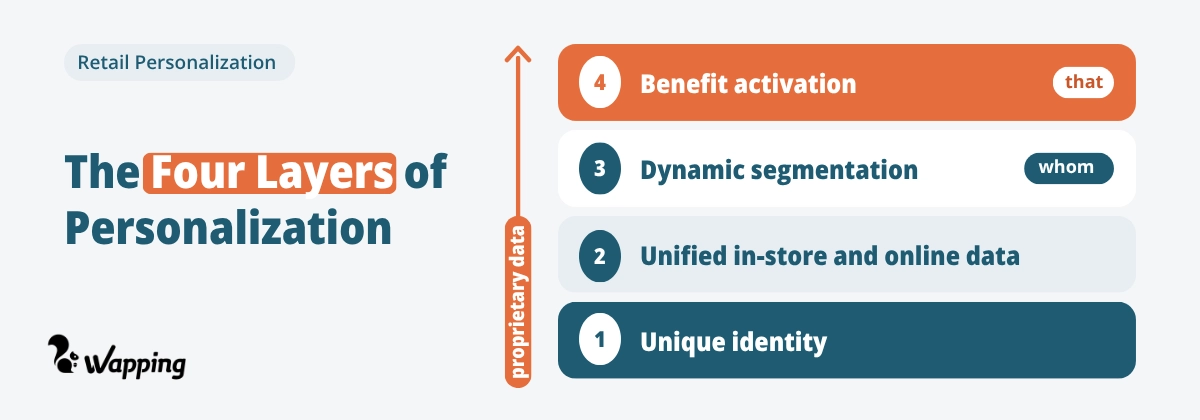
Personalising with first-party data isn't a tool or a copywriting trick. It's a stack of four layers, each resting on the one before:
- Unique identity. Knowing who is who, on any channel.
- Unified behavioural data, in store and online. Knowing what they really do.
- Dynamic segmentation. Deciding who.
- Benefit activation. Deciding what, when and through which channel.
When one fails, personalisation stays a promise. One by one.
Layer 1 · Unique Identity: Knowing Who You're Dealing With
Without knowing who is who, nothing else holds up. The same customer shows up as three different people in three different systems and, when a campaign goes out, receives offers for things they've already bought. The answer isn't cleaning duplicates every quarter, it's stopping them from being created: a unique customer ID, built on the validated mobile number and verified with a one-time OTP code the first time the customer identifies themselves, whether in store, on the web or via WhatsApp. From then on, that ID recognises the customer at any touchpoint, without them having to repeat their details on each channel.
Layer 2 · Unified Behavioural Data in Store and Online
With the customer identified, it's time to bring together what they do. Sales and returns, in store and on ecommerce, plus the events that aren't transactions, are captured automatically and tied to the same profile, without stitching and cleaning data silos by hand. It's the difference between knowing Marta bought online on Thursday and knowing that on Saturday she went to the city-centre store to exchange the size.
Returns count too: the system works with net value, meaning sales minus what has been returned. A customer who buys a lot and returns almost everything isn't the good customer they appear to be.
What makes it possible to unify POS and ecommerce data in a single live profile is exactly what a retail CRM built to manage contacts can't solve on its own. And it's the layer most often underestimated: without it, the online customer and the in-store customer remain two strangers.
Layer 3 · Dynamic Segmentation: Who
A list exported on Monday is out of date by Tuesday. A living audience updates itself: the customer moves in and out of the segment based on their behaviour, in real time in some segments and with evaluations roughly every two hours on average in the rest. Marketing defines the criteria across more than 50 parameters, with no code, and doesn't open an IT ticket every time a rule changes. A single customer can sit in several segments at once, and criteria can be combined: frequency, value, category purchased, channel.
That's ecommerce campaign personalisation without IT in practice: the person who designs the campaign is the one who runs it. If you'd like to see how these audiences are built, we explain it in our article on dynamic segmentation in retail.
Layer 4 · Benefit Activation: What, When and Through Which Channel
Segmenting well and then handing everyone the same discount throws the work away. The benefit is calculated and applied at the moment of payment: the POS or the ecommerce site queries Wapping in real time, and Wapping returns what applies to that customer, per line item or for the whole basket. It responds in 400 milliseconds on average, with no price changes in the ERP and no discount codes to create. That's the transactional gateway.
If two benefits coincide, incompatibilities let one override the other, with priority managed at the service level, so promotions don't stack up uncontrolled. And because the benefit is decided at the moment of payment, it can be made conditional on a minimum purchase or on categories with enough margin. It's personalisation that doesn't burn margin.
Communication goes out through whichever channel fits best: email, SMS, push or WhatsApp, the latter for very specific segments where the channel is already active, not as a mass send. If you'd like to see the full journey of a purchase, from identification to the benefit at the till, it's explained step by step.
3. What It Looks Like When All Four Layers Work Together
An illustrative example, to bring it down to earth. You want to launch an exclusive hoodie promotion for people who bought jeans in the last three months but didn't buy a hoodie.
With a classic stack, that means involving several departments, data extractions, configurations across several systems and testing beforehand. Most of the time it never launches, or it launches late.
With the four layers, the customer is already identified (1). Their jeans purchase in store and their visit to the website sit in the same profile (2). Marketing defines the segment once and it updates itself (3). And the benefit is applied at the till when the customer pays for the hoodie (4). Nobody has opened an IT ticket.
Notice what changes. There's no longer a discount for everyone: there's a benefit for a specific customer, on a specific purchase, and it can be measured too, because it's redeemed at the till.

It's what turns an omnichannel loyalty programme into something the customer actually notices, and not just one more card in their wallet.
4. Data First, Message Second
Personalisation doesn't start with the copy: it starts with identity. If your personalisation isn't working today, before you touch the message, ask yourself which layer is breaking. Do you know who the customer is? Can you see what they do in store and online? Can you segment without asking IT for help? Does the benefit reach the till?
If you have to choose where to start, start with the lowest layer that's broken. There's little point sharpening a segment if the same customer keeps showing up three times.
If you'd like to see it applied to a real case, find out how Wapping works.