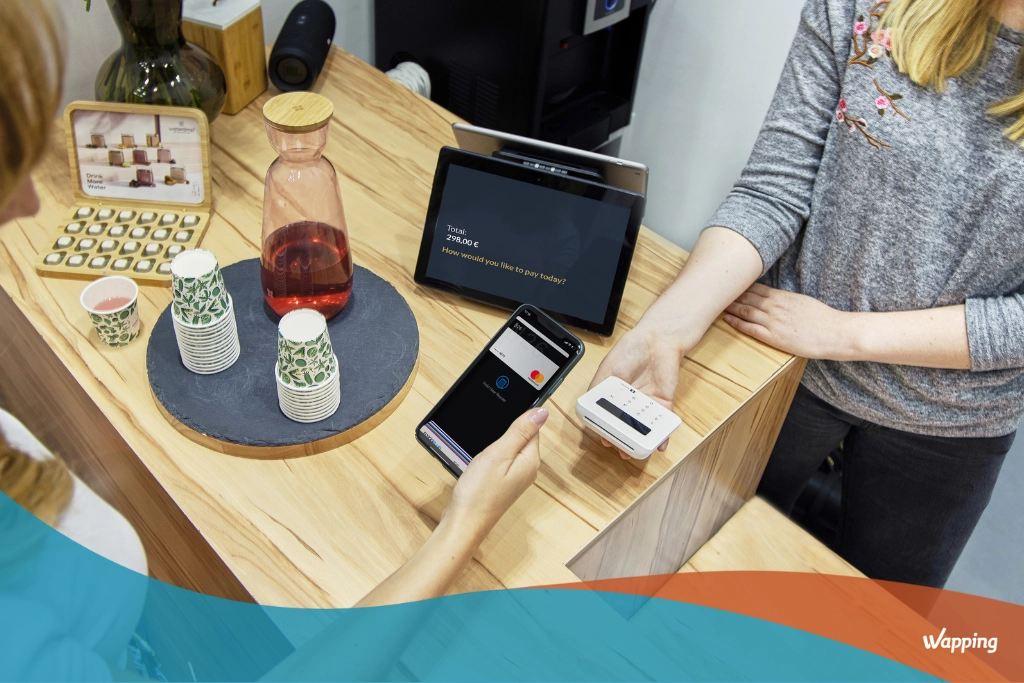
The benefit that decides a purchase is the one applied at the register, at the moment of payment. Everything that arrives earlier, the email with the coupon, the SMS with the code, the in-app promotion, is a promise. What arrives afterwards is a calculation still pending. The headless loyalty & promotion engine exists to close that gap: so the discount, the points or the cashback are calculated and applied while the customer is paying.
Sounds like a technical detail? It decides whether the customer notices the program at the register or only in their inbox. From here on: what a headless loyalty & promotion engine is, how it works at checkout, how it differs from an emailed coupon, and what changes for marketing and for IT.
A benefit promised now and applied later
Think about the last coupon campaign you ran. The customer gets the email, saves the code and uses it, or doesn’t. If they make it to the register, someone has to remember to type it in or scan it. If they buy online, the code has to exist in the store, with its own rules, without clashing with another promotion. Every step is a place where the benefit gets lost.
Any retail director will recognize the outcome: promotions disconnected from one another, friction at the checkout line, and a customer who leaves not knowing whether the program gave them anything. Three symptoms, one root cause. The benefit lives outside the moment of payment.
And there’s a second problem, less visible. A system that only keeps count of what has been accumulated can tell a customer how many points they have. What it can’t do is decide, at the moment of payment, what that person is entitled to on that basket. That takes another piece.
It also weighs on margin. A program that hands the same discount to everyone, without knowing who it’s going to or on which basket, burns margin without building loyalty. Deciding the benefit at the moment of payment, with the customer identified, makes it possible to tailor it to each basket instead of spreading it evenly.
What a headless loyalty & promotion engine is
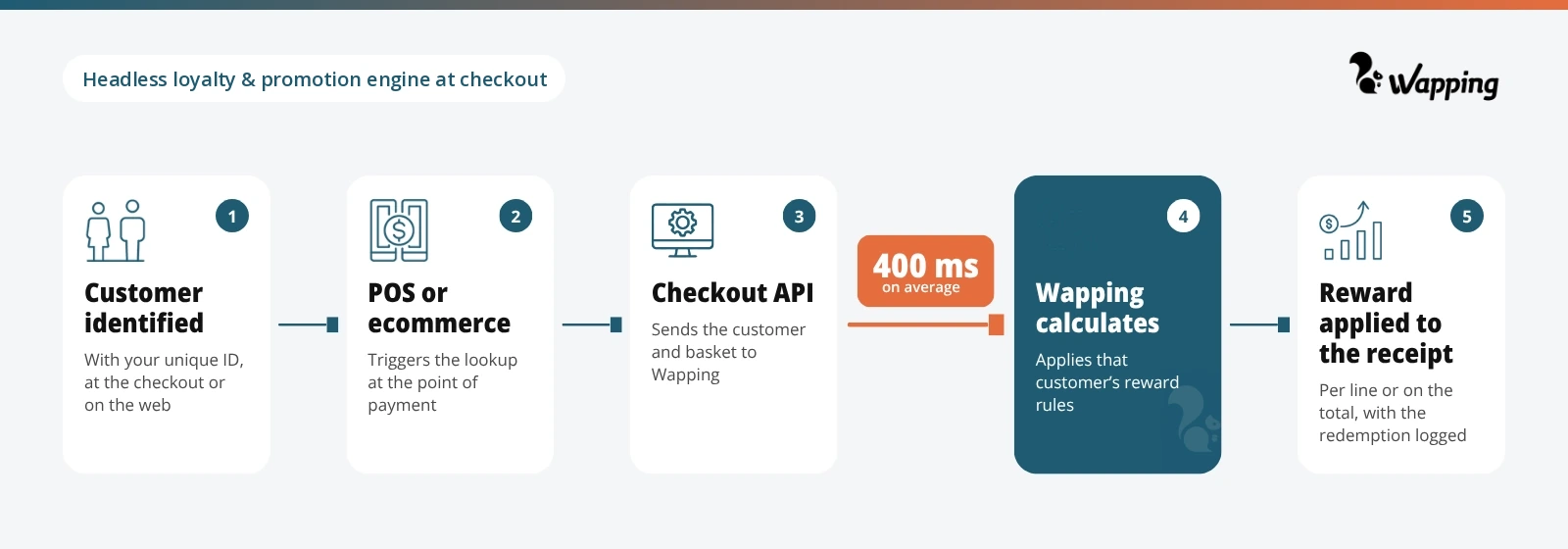
A headless loyalty & promotion engine is the layer that calculates benefits outside the checkout and responds to it in real time. When the customer is about to pay, the POS or the ecommerce site queries Wapping. Wapping calculates everything that applies to that customer and sends it back already worked out: line-level or basket-level discounts, points, cashback and promotions.
What matters is that it works the same way in both worlds. The engine for promotions, points and benefits is applied in real time at checkout, in physical stores and online alike, so the customer doesn’t live two different programs depending on the channel they pay through.
The conversation between systems is a call to a REST API, the Checkout API, and it takes 400 milliseconds on average. Under half a second between the POS asking and knowing what to apply.
For the engine to know who it’s serving, the customer has to be identified. That identification relies on a unique customer ID validated by OTP, a topic we covered when explaining the difference between CDP, CRM and DMP.
How it works, step by step, at checkout
It’s the same journey in a physical store and on ecommerce:
- The customer is identified. At the register or on the ecommerce site, with their unique customer ID.
- The checkout queries Wapping. The POS or the ecommerce site calls the Checkout API at the moment of payment.
- Wapping calculates. It applies the rules for the benefits that correspond to that customer.
- The checkout applies the result. It receives what was calculated per line item or for the basket total and reflects it in the purchase.
- The redemption is recorded. Because the benefit is redeemed at checkout, the transaction and the benefit stay linked.
Headless loyalty & promotion engine vs. a points-tracking system
Some loyalty platforms keep the books very well: how many points each customer has, what tier they’re on, when points expire. They are tracking tools. They record what happened.
A headless loyalty & promotion engine does something else: it steps in while it’s happening. It doesn’t log afterwards what the customer bought, it decides at payment what gets applied to that basket. It’s the difference between reading the statement and standing at the register.
In an omnichannel loyalty program, the two don’t compete: they solve different problems. At Wapping, points are just one of the benefits the engine calculates and applies. It isn’t a points-tracking system, it’s a headless engine that operates at checkout, which is why the benefit is applied at the moment of payment rather than promised for later.
Benefit applied at checkout vs. email
The emailed coupon and the benefit at the register pursue the same goal by different routes. The comparison, in short:
- Emailed coupon. Promised beforehand and delivered afterwards, if the customer remembers. Needs a code that is created and recognized by the checkout. Measurement is approximate.
- Benefit at checkout. Calculated and applied at payment. No discount code required. Measurement is direct, because the redemption happens inside the transaction.
That doesn’t mean email has become redundant. It’s still a perfectly good way to let a customer know a benefit is waiting for them. The difference is where the promise is kept.
Applying discounts at checkout in real time without touching the ERP
What has to change in your systems to launch a promotion through a headless loyalty & promotion engine? Less than you’d think. The promotion is created in Wapping. There’s no need to change prices in the ERP, create discount codes or distribute item masters. The POS or the ecommerce site, connected to Wapping in real time, receive what to apply to each line or to the basket total, already calculated.
That split moves the work around: marketing decides who the benefit is aimed at, with the help of no-code dynamic segmentation, and IT doesn’t open a ticket every time a rule changes.
And if two benefits overlap? There’s a concept of incompatibilities: it lets you inhibit some benefits when others apply, and priority is managed at the service level.
For the technical team, the connection is the same in physical and digital: a single API, the checkout one, is enough to connect a modern POS, and the most common ecommerce platforms have native modules. The POS integration is carried out by the POS’s own integrator, and there’s a test environment with a point-of-sale simulator to validate it before going into production.
Direct attribution: measuring every euro because the benefit is redeemed at the register
When the benefit is applied at checkout, the redemption is an event inside the transaction itself. There’s no need to reconstruct the story afterwards or guess which send pushed the purchase. Attribution is direct and total, not approximate as in traditional email marketing.
One point worth being clear on: what gets attributed is the redeemed service, not the communication. The dashboards show how many users converted a service or benefit over whichever period you choose, with no fixed attribution windows.
And the detail goes down to line level: the whole receipt is recorded, including the POS’s or ecommerce site’s own discounts and the payment methods. A headless loyalty & promotion engine leaves that trail effortlessly, because the benefit passes through the same point the payment does.
For a CMO who has to explain to the CFO what each action delivered, the difference changes the conversation: from “we think it influenced it” to “this benefit was redeemed on these transactions.”
How to tell whether your program needs a headless loyalty & promotion engine
Four questions, no technical answer required:
- Is the discount only applied if the customer remembers to show the code or the card?
- Do your in-store and ecommerce promotions follow different rules?
- Does marketing need IT every time a promotional rule changes?
- Could you say, transaction by transaction, which benefit was redeemed and which stayed in the email?
If any answer makes you uncomfortable, the problem isn’t in the campaign but at the point where the benefit gets delivered.
Wapping manages more than 80 million customers and 5 million events a day, and applies the benefit at the register in 400 milliseconds on average.
If you’d like to see how a headless loyalty & promotion engine works at a real checkout, see how Wapping works.